Featured Post

Holobionts: a new Paradigm to Understand the Role of Humankind in the Ecosystem

You are a holobiont, I am a holobiont, we are all holobionts. "Holobiont" means, literally, "whole living creature." It ...

Friday, October 6, 2023

The Breathing Goddess: What's Happening to Oxygen in our Atmosphere?


The Goddess herself has created the oxygen she breathes (image by Dezgo.com) 


There is a hugely interesting paper that appeared this year on "Annual Reviews of Earth and Planetary Sciences." It deals with the evolution of oxygen during the Phanerozoic.  The story of the ecosphere is all in there. Unbelievably, some 300 million years ago, the Permian fauna and flora lived in a concentration of oxygen of about 35%, nearly double the current one (about 20%). Even the dinosaurs of the Cretaceous breathed air with about 25%-30% oxygen in it. Ever wondered why the diplodocus was so big? That's one possible reason. 

In comparison, we are oxygen-starved. And we are further reducing the oxygen concentration by burning fossil fuels (it can be observed experimentally). All this may have to do with the different breathing architecture of mammals and birds (aka dinosaurs).

But why these oscillations? They may be the result of geophysical factors. The oxygen concentration in the atmosphere is related to the interplay of carbon sedimentation and sedimented carbon oxidation. The former is mainly due to plate tectonics, the latter to large igneous provinces and similar volcanic events. The winding down of oxygen concentration might be explained by a slowdown of plate tectonics and hence of sedimentation at continental edges, but that's far from being certain. 

I tend to think that it is an indirect result of the sun becoming brighter over the Eons. This increase in irradiation forces the system to reduce the CO2 concentration to keep temperatures within the range needed for life. But that will also indirectly reduce the oxygen concentration because oxygen comes from a photochemical reaction that involves CO2 molecules. Less CO2, less oxygen. And that means we are winding down with the ecosystem complexity: it means, basically, that the biosphere doesn't produce as much oxygen as it used to in earlier times. 

If the oxygen concentration goes below certain limits, metazoa will not be able to survive. In a few tens of millions of years, Earth may have reverted to protozoa only (single-celled creatures), as it had been for more than 2 billion years.

Unless someone starts burning a fraction of the sedimented carbon to increase CO2 concentration AND simultaneously manages to reduce the solar irradiation. Maybe good old Gaia has exactly that in mind!!

https://www.annualreviews.org/doi/full/10.1146/annurev-earth-032320-095425


Saturday, September 23, 2023

The Way of the Holobiont: a Simple Model


Lynn Margulis, the mother of all holobionts. 


The concept of holobiont has several definitions, the simplest one being "any symbiotic system." But that definition tells us little of what makes holobionts tick and it is often arbitrarily limited to microbial systems. The concept of "holobiont" is wider, and it is based on a functional definition: a holobiont is anything that behaves as a holobiont, that is, in terms of the interactions among the creatures that compose it. Here, the master trick is symbiosis, intended as a win-win interaction extended at the network level. In holobionts, all creatures are linked to each other (directly or indirectly) in a network of interactions that involve advantages for all the creatures involved. Holobionts are the result of natural selection that favors those holobionts that can obtain homeostasis -- the stability that allows them to survive and, hence, win the evolutionary game. 

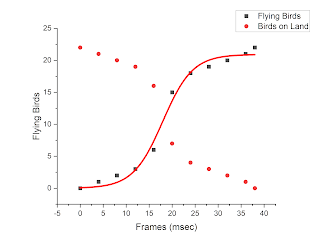
But how is this win-win mechanism? It is best explained by an example. Many kinds of systems, even non-biological ones, can function in the same way as microbial holobionts. So, the simplest network I can think of as an illustration of the holobiont mechanism is a flock of birds. Every bird communicates visually with other birds. There are several fascinating models of how bird flocks fly, but here let's see an even simpler system: birds foraging in a field. One bird sees something suspicious, it flies up, and in a moment, all the birds are flying away. There you go: 


You can see in the figure the fitting of the number of flying birds as a function of time using a logistic function.


The mechanism of this interaction is simple: one bird detects a predator and flies away. The message arrives to all the other nodes of the bird network as a "meme" a basic unit of communication. The meme "a predator is nearby" spreads all over the network and rapidly all birds fly away. Note that the bird that sees a predator acts only in view of its own survival: it does what it would do if alone. But all birds benefit from the bird acting as a "sentinel." It is a win-win strategy. Incidentally, human beings tend to do the same. A human crowd has two basic states: "calm" and "stampede." But even humans can be said to have just two states according to the principle proposed by James Schlesinger: complacency or panic. 

Let's try now to model this behavior. We can use the "SIR" (susceptible, infected, removed) model, well known in epidemics. We call "S" the number of "normal" members of the bird population, the number of panicked ones that flew away. R is the number of birds that recovered from panic and alighted again. 

Here are the equations of the SIR model: 

S'=- k1SI
I'= k1SI-k2I

The apostrophe symbol indicates the first derivative with respect to time. The k(s) are positive constants.  There is a third equation for R, but we don't need to write it since R' is simply equal to k2I.

This system doesn't have an analytic solution, but it can be easily solved iteratively. The result is the typical bell-shaped curve observed when an epidemic flares in a population. 


Note how not the whole population is infected; a fraction remains untouched. They have a "natural immunity" -- in this case a memetic immunity. This fraction can be calculated as approximately equal to k2/k1 (take the second derivative of S, and approximate I =0 for t>>0). The meme will diffuse more the larger the diffusion factor, k2, but that will be hampered by the decay factor, k3

The system is evolutionary. The k2/k1 ratio is calibrated in such a way as to optimize energy consumption: every bird that flies consumes a certain amount of metabolic energy that has to be compared with the energy that the flock would lose if one or more birds were not to fly. 

In general, for a flock of birds, the k2/k1 ratio is large, but it doesn't mean that all birds immediately fly away when they receive the "predator" meme. See this clip (featuring my grand-daughter, Aurora): 


You see that pigeons in a public park are much more difficult to scare than wild birds in the open. They have learned that humans aren't so dangerous, so the meme "a predator is here" doesn't generate the same quick flight response as the other video above. It is a case of "memetic herd immunity."

These are just initial notes on how the concept of "holobiont" is strictly linked to the network structure that creates it. Some network structures are much more complex than the simple "lattice" ones formed by a flock of birds or a herd of herbivores. A general theory that classifies these structures is the "Integrated Information Theory" (IIT) proposed by Giulio Tononi and others as an explanation of the phenomenon called "consciousness." 

Personally, I am not sure if consciousness can be measured in terms of the "phi" function proposed by Tononi, but the idea has interesting applications with holobionts since it deals with how many states a network can have. A flock of birds can have just two states, a human brain... well, let's just say a large (hugely large) number. So, holobionts could be classified in terms of their Phi value according to IIT. But this is a complicated subject that deserves to be discussed in more detail in another post. 


Saturday, September 16, 2023

Plenty of Reasons why we Need More Whales!


From Cook et al. 2020


2.2.2.1. Enhanced biodiversity and evolutionary potential

The ES (Eecosystem Services) of enhanced biodiversity and evolutionary potential, and enhanced primary production, are interrelated. Via the supporting ecosystem service of nutrient cycling, through abundant releases of iron from whale faeces and nitrogen from urine and faecal plumes, enhanced primary production occurs, including extended phytoplankton blooms (Lavery et al., 2010; Lundsten et al., 2010; Roman and McCarthy, 2010; Roman et al., 2014). In addition to ocean currents meeting and upwelling, the physical movement of animals in the water column, especially larger animals such as whales, contributes to the wider distribution of nutrients and oxygen in the water, leading to greater primary production (James et al., 2017). Areas rich in primary production also tend to be associated with an abundance of prey, and are thus often more biodiverse. In contrast, marine areas which have suffered losses of great whales have been associated with trophic cascades, leading to the associated stock decline of many other species, such as sea otters, kelp forests and birds of prey (Wilmers et al., 2012; Roman et al., 2014). In addition, the sunken carcasses of great whales, of whale falls, provide an important deep-sea habitat for more than 100 species that may be considered whale-fall specialists (Smith et al., 2019). The loss of these habitats as a result of commercial whaling is likely to have had a big impact on the diversity of whale-fall specialists in areas where whales have been hunted for centuries.

2.2.2.2. Climate regulation (carbon sequestration)

Over their lifetime, whales contribute to the removal of carbon from the atmosphere through the accumulation of large amounts of carbon in their bodies (Smith and Baco, 2003; Roman et al., 2014; James et al., 2017). After death, whales sink to the ocean floor. So-called ‘whale falls’ result in the locking in of organic carbon content on the sea floor. Smith and Baco (2003) reported that the carcass of a 40-tonne grey whale can contribute a level of organic carbon content equivalent to around 2000 years of the background flux. In addition, a study by Pershing et al. (2010) reported that restoring baleen whale stocks to pre-whaling levels would remove 1.6 × 10⁵ tons of carbon each year through whale falls.

Tuesday, September 12, 2023

How to Freeze a Holobiont: The Great Proterozoic Catastrophe


Image created by Dall-E


One of the great features of climate science is that you always learn new things. It is the story of how our planet evolved, changed, and arrived where we are, silly naked apes as we are. One of the most fascinating moments of this long history is the "Snowball Earth" period. Some 700 million years ago, in the Sturtian period, at the end of the Proterozoic Eon, the whole planet got frozen, covered by an ice sheet. Yes, Earth was all white, ice-covered, and nicely frozen. The great holobiont that some call "Gaia" nearly died. It may have survived, barely, because some small areas, maybe volcanic hot springs, remained ice-free.

Why this event? An ongoing research effort is aimed at unraveling the story. The latest results show that the great freezing was preceded by the "Franklin Large Igneous Province" (Franklin LIP). It was another spectacular event but for the opposite reasons. It involved a gigantic volcanic eruption that spread molten lava over a huge region that went from the regions now called Alaska and Greenland. It lasted about one million years. Earth's history is never boring!

Now, some recent data show that the Franklin LIP took place immediately before the great Snowball Glaciation. And the proposal is that the LIP caused the snowball. 

Great, but one moment. There have been several Large Igneous Provinces, LIPs, in the later history of Earth. In most cases, the result was warming, not cooling. The "great dying" of the end of the Permian, about 250 million years ago (at the "Permian-Triassic" boundary) was caused by a giant LIP in the region called Siberia today. The demise of the dinosaurs (apart from birds) was caused by another huge LIP taking place in the Deccan region in what is now India (an asteroid may have helped, but the LIP was probably the main cause). Smaller LIPs also caused havoc in the ecosystem. 

The basic idea is that these huge eruptions inject large amounts of CO2 into the atmosphere, generating a rapid and catastrophic warming that, in turn, causes a dieoff in the ecosystem. So, what did the Franklin LIP have that is different from the more recent LIPs? Is this a new demonstration that climate science is all wrong, actually a hoax created by the appliance industry to force us to cook on induction stoves?

Well, no. If you know the basic mechanisms that control CO2 concentrations and consequently Earth's temperature, the story makes plenty of sense. The Franklin LIP was not different (not so much, at least) from the later LIPs. But the world in which these eruptions took place was completely different. 

Let's start from the beginning: How do LIPs emit CO2? It is because the volcanic lava contains carbonates, compounds that can decompose, producing CO2 and oxides. As for all chemical reactions, the equilibrium between CO2 release and uptake depends on temperature. At the high temperatures of molten lava, carbonates tend to decompose, but, when the lava cools down, the reverse reaction occurs. Now, CO2 reacts with silicates to form carbonates. If the mass of lava is truly huge, as it was in the Franklin LIP, then it is no surprise that the CO2 drawdown is massive. If the temperature is hot enough, but not too hot, the drawdown is also rapid, at least on the geological time scale. Starved of CO2, the atmosphere doesn't act any longer as a blanket to keep the Earth warm. Bang! It is snowball Earth. 

Now, there comes the fundamental point: at the time of the Franklin LIP, the interplay between CO2 release and uptake took place in a relatively simple world: There was no life on land; it only appeared a couple of hundred million years later. So, since the LIP took place mainly on land, it didn't interact with the land biosphere. Then, fast forward 400 million years in the future, and you are now seeing the huge, gigantic, enormous, appalling lava landscape that we call the Siberian LIP. Same thing as before, but with a profound difference. By then, life had spread on land and had plenty of time to create huge reservoirs of carbon that resulted from the decomposition of living matter. This carbon we call "coal." In addition, there were also reservoirs of kerogen (solid hydrocarbons dispersed in the soil) and those hydrocarbons that the naked apes living today on Earth call "fossil fuels." 

Imagine the lava spewing out from the Siberian LIP going through this mass of fossil carbon, and you see that there was a factor that didn't exist with the Franklin LIP: coal was burned by the hot lava and turned into CO2. The same thing happened some 190 million years later with the Deccan LIP. Huge amounts of carbon were turned into CO2 and the resulting warming wrecked the whole ecosystem. Bang! Another mass extinction (the poor dinosaurs were boiled alive). That was the rule with all the Phanerozoic LIPs; their correlation with mass extinctions is reasonably well established, although the details can be complicated. You can find more information in this paper by Ernst and Youbi.

And there we stand: the story of life on Earth is an incredible adventure that sees the geosphere, the atmosphere, and the biosphere interacting with each other, usually resulting in a certain degree of stability but sometimes leading to great upheavals. It is what's happening now, with a large tribe of naked monkeys having taken control of the biosphere and playing the role of a Large Igneous Province by burning the huge reserves of fossil hydrocarbons built over the Phanerozoic Eon. For sure, this new "artificial LIP" will not lead to cooling but to warming. A huge and rapid warming. Gaia will probably survive it, but the monkeys... well, it all to be seen


A simple discussion of the recent results on the Franklin LIP  can be found on Anton Petrov's blog.

How Gaia survived Snowball Earth is described in this post by Ugo Bardi https://theproudholobionts.blogspot.com/2022/12/how-gaia-saved-earth-from-cold-death.html

The paper on the Franklin LIP by Dufour et al. that stimulated this post can be found at https://www.sciencedirect.com/science/article/pii/S0012821X23002728

The link to the paper by Ernst and Youbi on mass extinctions is: https://www.sciencedirect.com/science/article/pii/S0031018217302857

If you cannot access these papers, ask me for a copy


Tuesday, September 5, 2023

Can Holobionts Love Each Other?


Two holobionts enjoying each other's company. Sara peacefully sleeps in the "arms" of a beech tree on the Amiata mountain. She is obviously happy to be embraced in this way; we are tempted to think that the tree thinks the same.

Do trees perceive the world around them? Absolutely yes, but in a very different way from how we humans do. Trees have no eyes, no muscles, no above-ground nerves. But they perceive chemical signals, light signals, vibrations, and, probably, things that we don't even imagine could be perceived. So, the tree gently holding Sara cannot "see" her. But it can perceive her presence in the form of vibrations and chemical signals. The tree perceives Sara more or less how we could perceive a ghost. 

And what does the tree think of Sara? The brain of the tree is below ground; it is the vast network of connections of the root system, boosted by the help of fungi. It is called the mycorrhizal system. Maybe this alien brain can form an image of the strange creature resting near its trunk, although, for us, it is nearly impossible to understand in which form. Maybe the tree is asleep, too. And what does it dream? We can't know, just as we can't know what Sara is dreaming. The only thing we can say is that there is no reason to think that holobionts can't be in love with each other. 


h/t Sara


Saturday, August 26, 2023

Lichens and Lichen Lovers. Holobionts Everywhere


Irene, a young biologist from Abbadia San Salvatore, embraces a beech tree growing on the slope of the Amiata Mountain in Tuscany, Italy. Note the white lichens growing on the surface. In addition to being a tree lover, Irene is also a lichen lover. And a holobiont, too. 


"Life did not take over the globe by combat, but by networking" -- Lynn Margulis, 1996


It is not so easy to find fellow lichen lovers. Lichens are so common and yet so misunderstood and ignored, despite being the quintessential example of a holobiont. They are creatures formed of two completely different species, a fungus and an alga (or a cyanobacterium, not the same thing as an alga, but functioning in a similar way). Algae and cyanobacteria are photosynthetic organisms that provide food for the fungus. The fungus, in turn, digs up mineral nutrients from the substrate and provides them to the algae/cyanobacteria. A perfect example of symbiosis, lichens have existed for hundreds of millions of years, possibly billions of years, and they probably were the first organisms to colonize the land in very ancient times. 

Once you discover lichens, you can't avoid being fascinated by their incredible variety of shapes and colors. They can have tiny, leafless branches (fruticose), flat leaf-like structures (foliose); they may form  a crust that adheres to the substrate, (crustose), have a powder-like appearance (leprose); and more. They give you some ideas of the overall health conditions of the biome in which they appear, especially if they appear in the foliose state. Some of them are edible and they have been appreciated as food by many traditional culture and also by reindeer. Below, a print shows Japanese lichen collectors


In our culture, lichen lovers are a little rare, but they do exist, and when they find each other they may engage in lyrical appreciations of the lichens they observe, as I did when I met Irene, in the woods of the Amiata mountains. There is a facebook site on lichens (unfortunately it has not been updated during the past three years), an active "società lichenologica italiana", a "British Lichen Society,"  and you can surely find many more sites on the subject by searching the Web. But the mere fact of seeing these little creatures for what they are is a source of endless wonder. You don't need to be in the wild. You can find plenty of lichens anywhere in urbanized areas. 

Here are some white lichens growing on the nearly forgotten tomb of Vernon Lee (1856- 1935) British writer and poet who lived most of her life in Tuscany. Poetry is a form of virtual holobiont growing in the mind. 


h/t Irene Mazza, Cinzia Mammolotti, and Miguel Martinez


Saturday, August 12, 2023

Why Naked Apes have Small Mouths. Explained by Meuianga Mera, Chief Scientist of the Reptilian Starfleet


-- Egad.... Meuianga. What would that be?
-- You are teasing us, Meuianga. What is this ugly mess?
-- Looks disgusting. 
-- Aie... disgusting, indeed. Is it something vomited by a Nawipkeyzätx?

Wait, wait, cadets. Don't jump to conclusions too fast. If I am showing you this thing, it is because it is part of your training. And let me tell you that the Apes call it a pizza, and they eat it. It is made with ground vegetable seeds, some meat and other vegetable matter

-- Do they?
-- Really, they eat it?
-- Gosh.... unbelievable.
-- But how can they........?

Everything has an explanation, cadets. And not every species in the galaxy has the same uses we have. I know that we all love meat bitten from freshly killed prey, but, my dear pupils, let me ask you a question. How often could you indulge in killing a Leetlapxkxay and eating it raw, recently?

-- Ah, well, Meuianga, that's true
-- We are in a spaceship. Not easy to find a Leetlapxkxay inside
-- And the trip was long. Even a good reptilian hunter has to come to terms with reality. 

Yes. So we all are used to our super-meta rations. They are good. They give us strength. Though, I must say, not so tasty. But that's another matter. Today, I want to explain to you how the naked apes of planet Earth deal with food. And it is a matter that's linked with other features of this species. You remember that in our previous lesson, I was telling you about the function of this species fleshy excrescences that they call "lips." But another interesting feature of their mouth is how small it is. Let me show you a picture of one of them. Incidentally, even though she is an ape, she is rather smart. She is, actually, one of their best scientists. Maybe, one day I'll have her beamed up to our spaceship, so you can meet her. Chatting with these creatures can be quite entertaining. But here is the picture I mentioned,


-- Uh? Is she really one of those naked apes?
-- She looks like an insect!
-- Weird. With those large eyes!
-- She doesn't even have pupils! 

No, no, cadets. She is not an insect. She is one of the apes we are studying. She is just wearing over her biological eyes an implement that they call "glasses" -- it is another kind of secondary sexual signal for them, but we'll go into that in a later lesson. I am showing this image to you because this young ape shows rather clearly the feature I wanted to discuss today: the small mouth. Indeed it is small. Compare it with your mouth, and you can see that. I can also show you a comparison with the mouth of another ape species of this planet. It is a creature they call "Chimp" and that of a naked ape. They are both primates, closely related to each other in genetic terms. But the mouth of the naked ape is much smaller.


And you see that the mouth of the naked ape is indeed much smaller than that of other species of ape. Now, the question is why. Can you guess? 

-- I have an idea, Meuianga. Does it depend on what they eat? 

Good observations, cadet Hämi Te Yuepxoe 'Ipxpaä'itans. And, indeed, it is a possible explanation. I can tell you that my first impression when I examined the mouth of these creatures was that they, indeed, suck blood. Several species on this planet survive on the blood of other creatures. The naked apes call them "vampires," and we use this term, too. 

-- Is it true, Meuianga? Do they really suck the blood of other creatures?
-- Are they all vampires?

No, cadets, not really. Even though, occasionally, they do, but they don't survive on that. Vampires are small creatures that eat the blood of much larger ones -- they can do that because they are so small that they don't kill their target. On planet Earth, the largest vampire species we could identify are called "bats" by ape scientists. They are truly small. About a hundredth of the weight of a naked ape. To keep the proportion, these apes would need to feed on creatures so large that they couldn't exist on this planet. Gravity would crush them!

-- Ah, good, Meuianga. In a sense, we are reassured.
-- These apes are interesting creatures. But vampires.... well, it would truly disgusting. 
-- And worrisome, too. 

Don't worry, cadets, these apes are not going to suck your blood. To be sure, they have some strange stories about creatures of their size doing exactly that. But I never could verify these stories, so I'll just assume that they are part of that virtual world that apes call "legends." In any case, the reason for the small mouth is perhaps even more interesting than if they were vampires. 

-- You are making us curious, Meuianga
-- Tell us the reason! 

Well, cadets, there are two possible reasons, one of which I don't think it is completely satisfactory, but it is worth examining nevertheless. And it has to do with the object I showed you at the beginning of this class. 

-- Ah.... the thing you called "pizza"?
-- And you say they eat it?

Yes. the story is that they eat pre-digested food. 

-- ........?
-- Do they......?
-- Really?
-- Sound truly awful. 
-- Yecchh....
-- But what does that mean, "pre-digested"?

Ah... simple, cadets, simple. You know that digestion is a process that breaks down the components of food into its basic components. It is done by several enzymes secreted by the body. Now, something similar can be done by heating the food, a process that the apes call "cooking."

-- Cooking?
-- We never heard of anything like that.
-- What would that be?

It is a form of pre-digestion. For instance, it denaturates proteins into more easily absorbable forms, and it also breaks down the cell walls to free nutrients, and much more. Cadets, let me tell you that these apes are quite sophisticated in their idea of cooking. And it is an interesting, very interesting cultural pattern. Those pizzas are, actually, very good. 

.. Er... Meuianga, what does that mean?
-- You ate ape-made pre-digested food?
-- Is that true?

Cadets, a Reptilian scientist is not afraid of personally testing the subjects she studies.

-- Yes, Meuianga, but pre-digested food...
-- Aw... yes. It sounds, it sounds like....
-- Gross.... it sounds gross.

I know, cadets, it sounds disgusting. But it is part of your training. 

-- Eh...? Do you mean we'll have to....?
-- Really?
-- Did you.... did you eat this thing? This "pizza"?
-- Is this a test we have to pass?

Not now, cadets, not now. But as you progress in your training, you'll have several tests to pass. And you might as well like pizza....Or maybe you can start with the kind of food they call Sushi. It is raw fish.

-- Ah... it sounds better
-- A good reptilian warrior eats raw fish.
-- Of course she does. 

Yes, and raw fish comes with a dose of aromatized ethanol called Sake, which has the purpose of altering a little your brain's synaptic activity. You may try that too. 

-- Meuianga, please, do not shock us so much.
-- We'll do that, if it is part of our training, but....
-- Meuianga.... please...

Cadets, I am sure you'll do your best. But let me go back to what we were discussing. We were examining the small mouth of the naked apes, and this idea of the pre-digested, or "cooked" food may explain it. If cooking makes food denser in terms of its nutritional content, then these creatures don't don't need to swallow large amounts and can have a smaller mouth. Doesn't that makes sense to you?

-- Maybe yes, Meuianga.
-- At least the way you stated it. 
-- But how does pre-digestion increase the nutrition content of food? 

Ah... this is a good observation, Cadet Kewpxzi'ì Te Lìpuaynin Stìuyi'itan. Cooking is mainly a help to make food more easily digestible, but it doesn't increase so much its nutritional value. But it is a reasonable explanation because it also makes the food softer, and so you don't need a big mouth to chew it. So, it is possible. Actually, it was proposed first by an ape scientist named Richard Wrangham some years ago. Here is an image of the "book" where he proposed it. Notice the funny thing on the head of the chimp - it is what they call a "hat" -- we'll discuss that later on.  


Wrangham is another smart ape; I met him a few times. He tried to convince me that his explanation is the right one, but I am not sure. Because, really, it seems not sufficient to me. Also, I think there is a much better explanation. But we have to go in-depth into the way these apes behave and this we'll see in another lesson. So, thanks for your attention, dear cadets, and have a nice relaxation with your daily super-meta. Or, if you like to try one of those things.... pizzas.... I can beam up one for you.

- Ah...
- Well.
- Maybe.
- And, after all, you are right that those super-meta rations are not so tasty. 
- Shouldn't we.... ?
- Why not?
- Meuianga.... we trust you!


h/t Ilaria Perissi